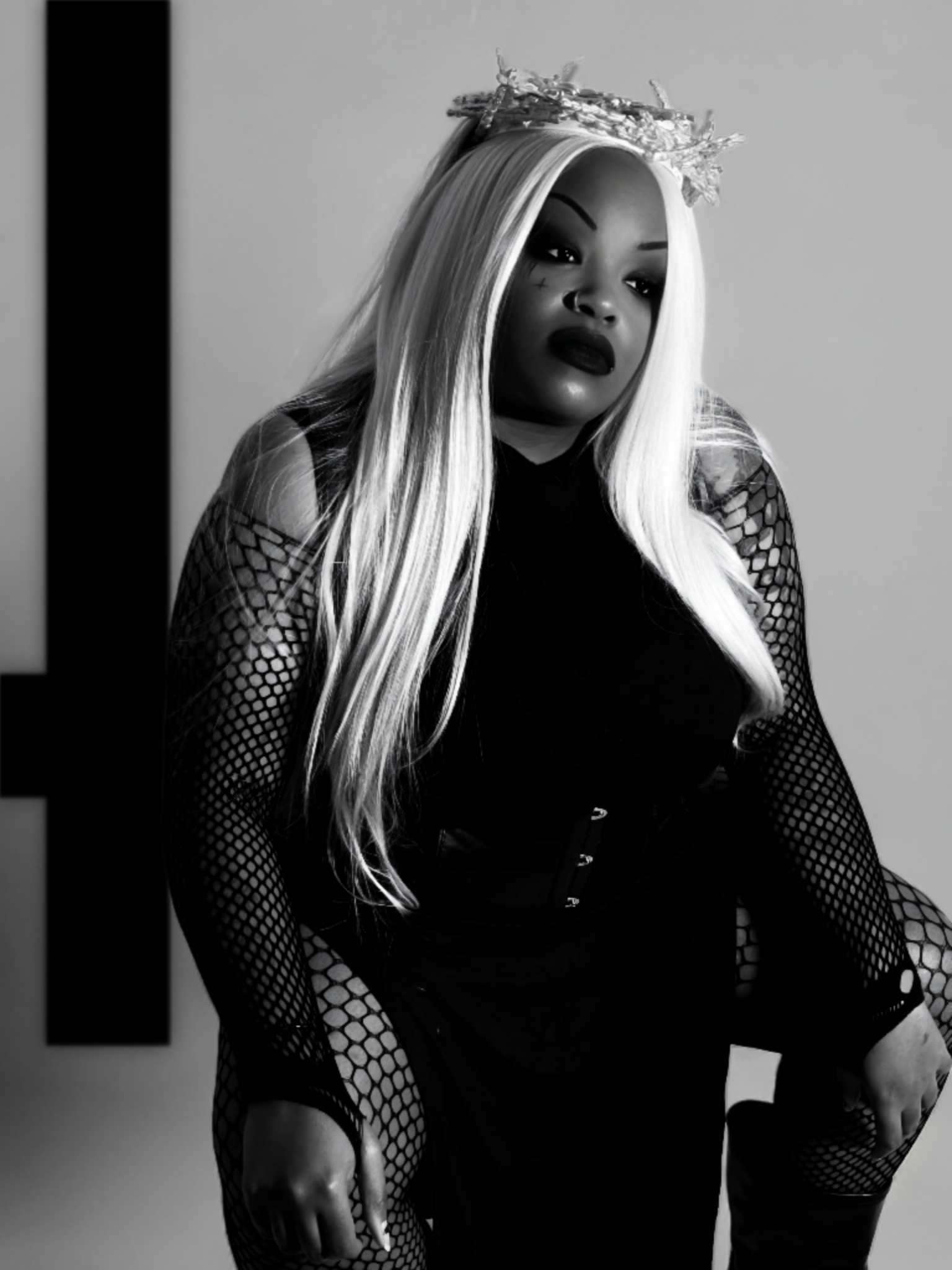

KillBylly is an enigmatic force in the New Orleans’ Goth scene. Blending dark wave, postpunk, electronic, and raw emotion– KillBylly has successfully transformed a drag persona into a deeply vulnerable musical project. In this candid interview, KillBilly opens up about the challenges of fitting into the local music scene, the intense vulnerability of their work, and the unique intersections of being Black, autistic, native New Orleanian, and femme in a space that often feels unwelcoming. From navigating the complexities of New Orleans’ post-Katrina (and post-Ida) art world to channeling personal struggles into hauntingly beautiful soundscapes, KillBilly’s story is a testament to resilience, self-expression, and defying expectations.
Where does this project come from for you?
Well, it kind of started off as a different drag persona when I was trying to step away from my previous persona and drag mom. I said, okay, well, I want to do drag, but also want to incorporate my own music. And then it kind of just turned into more of a music thing. The persona, KillBylly, is an amalgamation of my anger and disgust with the neurotypical world and the new New Orleans.
So how would you describe this project? I know a little bit of electronic. You cited some things like Art of Noise and Depeche Mode. How do you describe this?
That’s such a broad question. It’s going in a dark wave direction right now. I really don’t know. I don’t know how to, I’m really bad at describing anything that has to do with myself. I knew this was going to happen. I’m awful. I don’t know how to talk about anything I do. It’s a dark wave project. That’s just an outpouring of my innermost thoughts, the other parts of my mind, or conference room, that don’t get to talk as much, but they talk at me. But I don’t always let everybody hear what those parts of me have to say, but they definitely speak in my music. I’d say that it’s a big ball of mental health.
“A big ball of mental health.” I love that. I know you’ve talked about betrayal and mental health and coming out of the other side of things. So what is that like for you? Is it vulnerable?
Oh yeah, absolutely. It’s kind of scary. A lot of it is about not fitting in with typical society. I spend the majority of my life in this house looking out of these windows, and I very much experience the world that way even when I am outside of my house. It’s like I’m looking out of a window watching life go by. So a lot of what I write about reflects this position, definitely on the periphery of everything.
Why do you feel like you’re on the periphery of everything?
I just don’t fit. I didn’t even when I tried. Now I know that it is just Autism. People have kind of shown me that they don’t necessarily like my presence. So, over time, through therapy, I’ve learned to step away. I’ve kind of stepped away indefinitely. You know, I’ve been through a lot of things, a lot of interpersonal problems, a lot of abuse in relationships. A lot of things were overlooked in my childhood by some of the people who were supposed to protect me. All those kinds of things just showed me that maybe being a part of the general public is just not for me. So, I stepped away to prioritize my peace and keep myself as possible while I’m still here.
So, you set that boundary for yourself. Protecting yourself is very important. I’ve felt similar things where I’m like, okay, maybe this is just not the space for me. But going into the thoughts of space, doing something that is dark wave, electronic, and doing this in the setting of New Orleans as a black person, what does that mean for you? What is that like?
It’s hard. I will say that it’s, it’s difficult. I know that there are avenues that I could take to try to incorporate a bit more with musically like-minded people. I am afraid, though. My trauma and knowledge of some bad actors keep me from being able to trust them. Some attitudes make me feel unwelcome, so I feel cut off from the rest of the alternative and goth communities here. It feels that they don’t like people who speak out about injustices they see occurring in the community. I don’t know how to navigate to have people here take me seriously and listen to what I have to say. It’s to the point now where I’m kind of looking beyond the city because I don’t think that it’s going to work out here. I would give context about what I’ve experienced, but I am protecting other people who were involved.
Yeah. I hear a lot of musicians say that New Orleans is like, cause also being from here, this has always been like this really beautiful place for different blends of music and different people coming together. But It feels different now. There was this obvious change and shift after Hurricane Katrina, but there’s something that shifted after that. I’m not sure when or where or how, but there, there’s been another shift. And It’s like, how do you navigate that? Like who, who’s your audience? Like, who are you talking to? So what are your thoughts on that?
Oh, I’ve got a lot of thoughts on that. It’s just, it’s ridiculous. I get worked up about it all the time, and I have to reel it in. Because there’s nothing you can do about it. You just have to accept that this is how things are now because you’re right. The change did happen. It was a big shift. From what I see, if you are native to this area, you need to be making Jazz in order to be taken seriously. And if you’re making anything else, nobody cares. But if you’re from somewhere else and you come here with any genre, everybody’s going to support you.
But what about the people that were already here? Yeah, it’s like we’re overlooked. So, you know, once again, I’m just trying to move around it right now. Metairie is kind of where I feel comfortable because people know me there, and they hate me a little bit less than people in the city. So, I’m trying to make it work, but it’s awful that this is how things are.
Transplants look out for transplants. I see it. It’s a big, tight-knit community. If you don’t fall in line and do things their way, you’re a problem. I don’t do things the way a lot of people do things, and it makes me stick out, and I’m sorry, I don’t follow social hierarchy. It’s not my thing. I can’t follow along with things that don’t make sense. The song “Follow Me” is actually about my experiences with a fraction of the transplant community.
I think that’s inherently New Orleanian just to be like, yeah, I’m not doing that. So going back to your music, what do you think has been the most impactful song for you that you hear it and you’re like, “I did that. This conveyed everything that I wanted it to.”
Right now, it’s something that hasn’t been released.
When is it going to be released?
Oh, I don’t know. I haven’t come to that conclusion yet. I do want to drop one more EP before the year ends. So it will be sometime this year before the year is up. But it’s called “Sleep.” I wrote it in the middle of the night when I was supposed to be sleeping and took some Doxepin. I was supposed to be going to bed, but I didn’t feel sleepy. I felt very agitated, so I came in here in my office and said, well, let’s do something, and I wrote the song.
It doesn’t have a whole lot of lyricism going on, but it’s just, the motion and direction of the music and the way that it builds. I added some dialogue at the end that consists of things that people have said to me over the years, negative things. And these are the things that keep me up at night. These are the things that replay over and over.
I had to go through whole arguments in my mind with all these voices. It’s like a conference room in my head, and I want everybody to shut up so I can go to bed. I sat here and replayed it after I put everything where I wanted it to be. I listened to it, and it made me cry. It was actually really triggering to hear all those things said back to me, even though it was by a computerized voice. It was a lot to hear. You know, when you’re trying to program and produce, you have to listen to things over and over and over again. So, of course, I’m sitting here, and it’s just looping that one part. And I’m like, “Oh my gosh, what is this?” I know it may not impact anyone else, but my goodness, it’s like, this is the epitome of one of the biggest struggles I think that I personally face. Living with this, this brain of mine is so noisy, and I just want to rest. It’s incredibly hard to rest when you’re hearing all the people from the past telling you that you are awful all the time. So that would be the one that really was like, “Whoa,” for me.
Wow. That sounds like an incredible mix, like something that’s ugly and turn it into art and have it be beautiful in a way and have it impact you in a way. I’m sure when people hear that it’s going to be relatable. I can’t wait to hear it. Thank you for that teaser. So I know a lot of like what you have talked about, cause I know you mentioned like this brain of yours, a lot of what you’ve talked about in the past has been being black and autistic in these spaces. I know you mentioned in your band camp, you described yourself as “an autistic dropout music major.” So how do you feel like autism plays a role in this project, or maybe it doesn’t play a role at all.
It plays a huge role. I write everything from an Autistic point of view, like an alien describing human behavior. My experiences are curated by Autism. I don’t think that I would be as invested and as meticulous in my processes if it wasn’t for Autism. Music is one of my special interests. So, I’ve paid an incredible amount of attention to it. I don’t think I would do things the same way if it wasn’t for that. I probably would accept outside help.
I put all this on myself to do every part of this alone. My experiences as an autistic person are why I do things that way. I don’t trust other people to help me. I don’t trust other people to put a hand in anything because a lot of people are dishonest. So, I try to keep people at a distance. It’s funny I’m saying that because we’re doing this virtually. Keeping people at a distance, people are scary. It affects the whole process. It’s what I write about. My experiences are shaped by it. People see my Autistic traits as personal failings rather than a part of my disability.
Autism is just another part of the intersection. It’s a part of all of the things that help build a barrier, even though there were already barriers there because I’m agender, femme, Black, then you just add that. It’s another piece to this wall that’s keeping me from everybody else. And, you know, that all of that shapes the way I function in the way that I produce my music.
So you mentioned back in the beginning, a drag persona. What was it like doing drag? What was your experience with that?
It was fun, terrifying, liberating, and stressful. It was also a learning experience. It showed me just how much I needed to work on myself if I ever wanted to work with other people again. Now, I’ve found the help and diagnosis that I needed, but I avoid people.
How do you think you’ve changed from then as a performer? What’s going to be different with this project?
I plan everything, I practice hard, and I only rely on myself. I definitely don’t include other people as much in what I do now. If anything is going to fall apart, it’s going to be all on me. I will not rely on anyone else to get anything done. But I’m definitely more focused and have my eye on the prize, so to say. I practice, you know, I look all silly all around here with the microphone on, trying to get the perfect idea of how it’s going to go and say, okay, we’re going to do it exactly like that.
I didn’t exactly do that before. I kind of just ran out there and said, we’re just going to wing it and do whatever, but that’s, that’s not the deal. Now we plan, we plan really hard.
Where do you want this project to go? I know you talked about, you know, maybe this isn’t the space or the scene for you right now. Where are you looking to go?
Well, I would be happy if I could just make social media work for me. I’m terrible at keeping up with the way it works now. People want videos. They want, they want to really see you doing things, and I hate that. Um, I don’t like being perceived. So I don’t want a camera.
I don’t want to have to do stuff in front of a camera. Bad enough. I do stuff on a stage, and that’s taxing. So I don’t keep up with that really well, but if I could figure it out and get it just so that’d be great to just have people enjoy me from a distance. Stream the stuff, listen to it that way. Great. Wonderful. Beautiful thing. But it would be so awesome to connect with some other artists that I know in other areas, like Scary Black, who also goes by Albie Be Damned now. They are in Kentucky. They’re really cool. I would love to work with them at some point in time. There are a couple of people here, even Oktober Sky, I’d like to work with here.
Maybe playing a little show here and there would be nice, and just getting my messages out there. You can be disabled, make cool stuff, and still struggle. Also, we don’t have to be bystanders. We can jump into action and use our voices for those who can’t. I want to encourage people to think more about why they feel the way they do about different things in the world. Who taught you that? Who said that that thing is true? Why do you blindly follow? Do you know yourself? Those are some of the things I would like to encourage the masses to think about.
Many autistic people ask themselves these kinds of questions every day, throughout the day. I think it drives our extremely strong sense of justice. I personally think that the world would be a better place if we all would seek out justice and stand up for what is right.
I guess maybe one of my last questions would be, what is your hope for the New Orleans Goth scene? What is your wish? What would you like to see?
I would like to see some people take accountability for their mistakes. I would like to see some people address their biases and come forward and say, “We are a welcoming community.” I mean, I feel that outcasts of every color and creed should be allowed to be around, and right now that doesn’t feel true to it.
I would like to see them be more accepting and open to the people that were here before they got here. I’ve said this a few times, this particular sentiment that they have been able to build up their lives on the graves of the people that were here before them, and I want them to realize that– how much privilege they have.
They are inhabiting the homes of that generations lived in and ultimately died in for them to be there. I want them to take that into consideration and really hold that and really realize just how good they have it. Because if they love this city the way that they say they do. They should care about that and therefore you should treat all the people here with the utmost respect.
That– that’s what I would like to see.
You can find more about KillBylly by visiting their website and following them on social media or support their apparel line here.


![Get Your Copy of Folk Riot Magazine – Spring 2025 [TODAY]](https://folkriot.com/wp-content/uploads/2025/03/Untitled-design-2.png)


Leave a Reply